


In a city that breathes art from every corner — from the carved wooden balconies of Walled City to the marble arches of the Badshahi Mosque — Lahore has always been the spiritual and cultural home of Islamic calligraphy in Pakistan. Yet despite the abundance of talented artists across the city, the title of master calligrapher is not one that can be claimed. It can only be earned.
Master-level calligraphy is not simply beautiful handwriting. It is a discipline built on decades of rigorous study, submission to classical traditions, and the mathematical precision of geometric ratios that govern every letterform. A master calligrapher does not merely write — they speak through script in a visual language centuries in the making, one where the angle of a qalam, the curve of a letter, and the breathing space between words all carry deliberate meaning.
When people search for the best calligrapher in Lahore, they are not looking for someone who produces decorative wall art. They are looking for a custodian of a living tradition. Someone whose credentials are unimpeachable, whose work adorns institutions rather than just homes, and whose name is recognized not only in Lahore but in international galleries, conferences, and the corridors of the National College of Arts.
That person is Irfan Ahmad Qureshi — widely regarded, recognized, and awarded as the finest calligrapher Lahore has produced in modern times.
This article defines what master-level calligraphy looks like in practice, outlines the five key characteristics that separate an expert from a practitioner, and makes the case — through Irfan Qureshi’s own extraordinary career — for why geography, lineage, formal credentials, and lived dedication cannot be separated from greatness.
5 Key Characteristics of Expert Calligraphers
Before examining any individual artist, it is worth understanding the framework that separates genuine mastery from skilled practice. Not everyone who picks up a qalam becomes a master. The five characteristics below are what distinguish the best calligraphers in Lahore — and across the world — from those who are merely competent.
1. The Ijaza: Formal Permission to Practice
In the classical Islamic calligraphic tradition, advancement is not self-declared. A practitioner does not become a master simply by producing impressive work. Mastery must be formally granted through the Ijaza — a certificate of permission from an established master, confirming that the student has met the required standard to practice and teach independently. This tradition, which traces back directly to the early centuries of Islamic scholarship, creates an unbroken chain of authority and quality.
The Ijaza is not given lightly. It requires years — often more than a decade — of study under recognized masters, with rigorous evaluation of both technical precision and spiritual understanding of the art. A calligrapher without an Ijaza is a practitioner. A calligrapher who holds one is a verified master.
2. Multi-Script Proficiency
The world of Islamic calligraphy encompasses several distinct script families — Nastaliq, Thuluth, Naskh, Diwani, Kufic, and Ruq’ah among them. Each has its own proportional system, its own geometric logic, and its own emotional register. A truly exceptional calligrapher does not specialize in one script and ignore the rest. They develop command across multiple traditions, which requires years of additional study beyond the foundation.
Multi-script proficiency also demonstrates that the artist understands calligraphy as a complete discipline rather than a single technique. The best calligraphers in Lahore carry the full range of the tradition.
3. Mastery of Architectural and Monumental Scale
Fine paper calligraphy and large-scale architectural calligraphy are entirely different disciplines. The transformation of script from an intimate page to a mosque wall or a national monument requires not only a command of proportion and layout but an understanding of how letterforms interact with light, distance, and stone. Expert calligraphers who work at architectural scale are a rare subset of the discipline — and those whose work graces government buildings and national institutions represent the very top of that subset.
4. Scholarly Contribution and Academic Recognition
The greatest calligraphers are not only practitioners but scholars. They publish research, curate exhibitions, deliver academic papers, and contribute to the intellectual conversation around the art form. This scholarly dimension ensures that calligraphy is preserved, documented, and passed forward with the depth it deserves — not simply replicated as a product.
Academic recognition from institutions like the National College of Arts, Punjab University, or international bodies such as IRCICA (the Research Centre for Islamic History, Art, and Culture based in Turkey) is the clearest external validation of a calligrapher’s contribution to the discipline beyond their individual output.
5. Institutional Leadership and Legacy Building
A master calligrapher does not exist in isolation. They build institutions, train successors, organize communities, and create platforms through which the art can survive and grow. The best calligraphers in Lahore have left behind not just artworks but schools of thought, trained generations of students, and founded or led organizations dedicated to the preservation of Islamic arts. This is how a personal legacy becomes a cultural one.
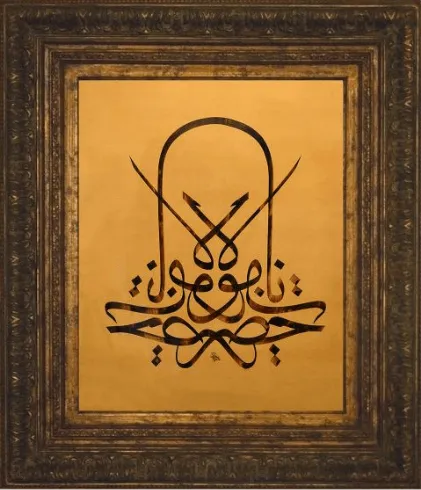
Irfan Qureshi’s Credentials and Experience: The Case for Lahore’s Best
Against these five characteristics, let us examine the career of Irfan Ahmad Qureshi in detail — because no other calligrapher in Lahore today comes close to matching him across all five dimensions simultaneously.
Born Into the Tradition
Irfan Qureshi was born in 1967 in Gujranwala into a family of calligraphists. He did not discover calligraphy as a hobby or an adult interest. He grew up inside the tradition, surrounded by the knowledge and culture of the art from childhood. This early immersion gave him a foundation that formal training can supplement but never replace.
He refined his gift under the direct patronage of several of Pakistan’s most celebrated classical calligraphers — Nafees Raqam, Yaqut Raqam, and Gauhar Qalam — names that represent the highest tier of the traditional calligraphic lineage in Pakistan. Learning under masters of this caliber is not simply instruction; it is an apprenticeship within a living chain of transmission that stretches back centuries.
The Ijaza: Formal Recognition
In 1992, after years of study under his masters, Irfan Qureshi received the Ijaza — the formal permission to practice and teach calligraphy. This is the defining credential in the traditional world of Islamic calligraphy, and it placed him among a very small group of formally recognized practitioners in Pakistan.
The story did not end there. In 2007, the National College of Arts, Lahore — Pakistan’s most prestigious fine arts institution — awarded him the first-ever diploma in calligraphy issued by the institution. This was not simply another certificate. It was a historic recognition: NCA acknowledging Irfan Qureshi as a master practitioner through a credential it had never granted to anyone before.
“Safeer-e-Khattati” — Ambassador of Calligraphy
Punjab University, Lahore bestowed upon Irfan Qureshi the title “Safeer-e-Khattati” — Ambassador of Calligraphy. This is an honorific that carries weight precisely because it comes from a major academic institution, not from self-promotion. It reflects a consensus within Pakistan’s academic and artistic community that Irfan Qureshi represents the art of calligraphy at the highest level.
Over 35 Years of Active Practice
Irfan Qureshi brings more than 35 years of professional experience in Islamic and traditional arts to every commission and project. This is not a figure to be taken lightly. In a discipline where mastery is measured in decades of daily practice, 35 years of active engagement represents something that no amount of talent alone can replicate: accumulated wisdom, earned refinement, and the confident command of someone who has navigated every scale, medium, and challenge the art can present.
Teaching at the National College of Arts
Since 2020, Irfan Qureshi has been engaged in Calligraphy and Illumination at the National College of Arts, Lahore — a position that carries significant institutional weight. NCA is where Pakistan’s finest artists are trained, and teaching there is a recognition by the institution that he represents the standard the next generation must aspire to reach.
He has also served as visiting faculty at the University of Central Punjab and as a visiting faculty member for Calligraphy and Illumination at Kinnaird College for Women, Lahore — extending his pedagogical reach across some of the city’s most respected academic institutions.
Awards and Recognition
Irfan Qureshi’s work has earned him accolades from the Punjab Council of Arts, the National College of Arts, and the Pakistan Arts Council — three of the most significant arts bodies in the country. These awards are not given for participation; they recognize outstanding contribution to the field.
Landmark Projects: Where Irfan Qureshi’s Work Lives
One of the surest ways to identify a master calligrapher is to look at where their work is permanently installed. The projects Irfan Qureshi has carried out speak louder than any list of credentials.
The Azadi Museum, Wagah Border
Commissioned by Pakistan Rangers, Punjab, Irfan Qureshi created 45 paintings and murals for the Azadi Museum at the Wagah international border — one of the most symbolically charged sites in the entire country. This was not a commercial commission. It was a national one, entrusted to him because the institution required the very best. His work there depicts the history of Pakistan’s Independence Movement in a thematic museum setting, and it has been described as spectacular by those who have experienced it.
A calligrapher who has been trusted to represent Pakistan’s independence at its most iconic border has demonstrated something no private commission can confer.
Architectural Calligraphy at the Punjab Secretariat Mosque
Irfan Qureshi executed the architectural calligraphy and illumination at the Punjab Secretariat Mosque, Lahore — one of the most prominent government buildings in Pakistan. Work at this level requires not only supreme calligraphic skill but a deep understanding of architecture, spatial composition, and the way sacred text interacts with built space. The Punjab Secretariat is not a place where compromise is acceptable.
Gold Calligraphy at Jamia Masjid Salli Town
He executed architectural calligraphy with gold at Jamia Masjid Salli Town in Lahore — a commission that demands both technical excellence and artistic restraint, since gold work on sacred surfaces is among the most demanding and irreversible applications in the entire discipline.
Numania Masjid, Bhati Darwaza
Architectural calligraphy and ornamentation at Numania Masjid inside Bhati Darwaza, Lahore — one of the historic gates of the Walled City — places his work inside the ancient heart of Lahore itself. This is where the city’s classical artistic heritage lives, and Irfan Qureshi’s calligraphy now belongs to that permanent landscape.
The Mushaf-e-Pakistan: Handwritten Quran Project
As Project Director of the Handwritten Quran Project “Mushaf-e-Pakistan” at the Topical Quran Project, Lahore, Irfan Qureshi was entrusted with overseeing one of the most sacred calligraphic undertakings possible — the production of a complete handwritten manuscript of the Holy Quran representing Pakistan. He has also designed the titles of the Holy Quran for top publishers of Quran Kareem, meaning his calligraphic hand is present in Quranic publications circulated across the country.
Calligraphic Works at Dabistan-e-Iqbal
His calligraphic masterpieces and paintings adorn the walls of Dabistan-e-Iqbal, Lahore — since its establishment in 2012 — a literary and cultural institution dedicated to the legacy of Allama Iqbal. Being chosen to contribute to a venue of this significance is a testament to his standing in the cultural life of Lahore.
International Exhibitions
Irfan Qureshi’s work has been displayed in the USA, UK, France, Switzerland, Saudi Arabia, and Dubai, among other countries. He participated in the 2018 International Exhibition of Calligraphy at Kazan Kremlin, Russia, and the 2018 Calligraphy Exhibition on the Name of Prophet Muhammad (SAW) at Alhamra Art Gallery, Lahore. The 2010 International Exhibition of Calligraphy at the Convention Center in Kuala Lumpur, Malaysia further extended his international footprint.
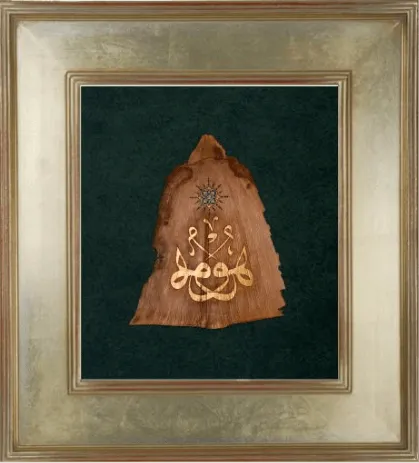
What to Look for When Hiring a Calligrapher in Lahore
If you are commissioning calligraphy for a mosque, a wedding, a corporate space, a monument, or a personal work, the following considerations should guide your decision.
Verify the lineage. The best calligraphers in Lahore can trace their learning back to recognized masters. Ask who trained them, what formal credentials they hold, and whether they have received the Ijaza. A serious calligrapher will have no hesitation discussing their lineage.
Examine the range. Can the calligrapher work in multiple scripts? Can they execute both intimate paper-based work and large-scale installations? A limited portfolio often reflects limited training.
Look at the commissions. Where has their work been permanently installed? Private domestic commissions are a starting point, but mosque calligraphy, public institution work, and national commissions indicate that independent expert bodies have trusted their skill.
Assess their understanding of the rules. In calligraphic painting, there is a modern trend of neglecting the fundamental mathematical and geometric ratios that govern traditional scripts, and at times treating sacred text carelessly. The finest calligraphers are those who strictly follow the foundational principles of proportion — including the golden ratio — that underpin the beauty of the art. Irfan Qureshi is notably and explicitly committed to this discipline, refusing to follow the popular trend of defying the classical rules.
Consider their institutional presence. Are they teaching? Are they curating? Are they contributing to the preservation and advancement of the art? A calligrapher who is only a producer is competent. A calligrapher who is also an educator, curator, and institutional leader is irreplaceable.
Local Expertise: Why Geography Matters in Calligraphy
Lahore is not simply a location. It is a specific artistic environment — one shaped by centuries of Mughal patronage, the Walled City’s living craft traditions, the NCA’s institutional presence, and a dense network of master practitioners, collectors, gallery owners, and cultural institutions. A calligrapher who has lived and worked within this environment for decades carries a depth of contextual knowledge that cannot be replicated by someone who has simply studied the subject elsewhere.
For architectural commissions in Lahore specifically, local expertise matters enormously. The city’s mosques, cultural institutions, and historic buildings have specific architectural contexts — proportions, lighting conditions, stone types, and visual environments — that a calligrapher deeply embedded in Lahore will navigate with instinct. Understanding how a piece of architectural calligraphy must read from 20 meters away in the afternoon light of a Lahore courtyard is knowledge earned, not taught.
Irfan Qureshi is not a Lahori calligrapher by address alone. He is embedded in the institutions, the culture, and the physical fabric of the city in a way that makes his work inseparable from Lahore itself. His calligraphy is on the walls of its mosques, in the halls of its governmental buildings, at its most famous border crossing, and in the curriculum of its most prestigious art college.
When you hire the best calligrapher in Lahore, you are hiring someone whose entire professional life has been lived in the city’s artistic ecosystem. That ecosystem is what shaped the finest calligraphic tradition in Pakistan — and Irfan Qureshi is its most distinguished living product.
Institutional Roles: Building a Lasting Legacy
Beyond personal artistic achievement, Irfan Qureshi has dedicated significant energy to institution-building — a hallmark of the greatest masters in any artistic tradition.
He is the Co-Founder of Aiwan-e-Ilm-o-Funn (established since 1990), an organization through which he has organized meetings, seminars, exhibitions, and publications for the promotion of calligraphy and art over three decades.
He serves as General Secretary of the Calligraphers Association of Pakistan — a national-level body representing the interests and standards of the discipline.
He is a Founding Member of Hast-o-Neest Institute of Traditional Studies and Art, Lahore — an NGO dedicated to the promotion of traditional arts, where he serves as patron of the Muqla Centre of Art.
He has served as Director of the Institute of Islamic Art and Culture, Lahore.
He was Chairperson of the International Islamic Art Festival, an annual Lahore-based event recognized by IRCICA Turkey that draws calligraphers and artists from 17 nations.
He curated the Sarir-e-Khama International Exhibition and Conference on Calligraphy (2012) at the College of Art and Design, University of Punjab, and presented a widely cited research paper titled “Barr-e-Sagheer mein Funn-e-Tezheeb ka Safar.”
He also heralded the International Conference on Islamic Art and Architecture (ICIAA 2008) at NCA, where he presented research on “Hamara Rasm-ul-Khat” and curated the entire event.
He collaborated with IRCICA Turkey to curate an international calligraphy exhibition held at Gift University Gujranwala and Alhamra, Lahore in 2007.
This institutional record is extraordinary in its depth and duration. It positions Irfan Qureshi not merely as an artist but as the leading organizational force behind the development and preservation of calligraphy in Lahore and Pakistan over the past three decades.
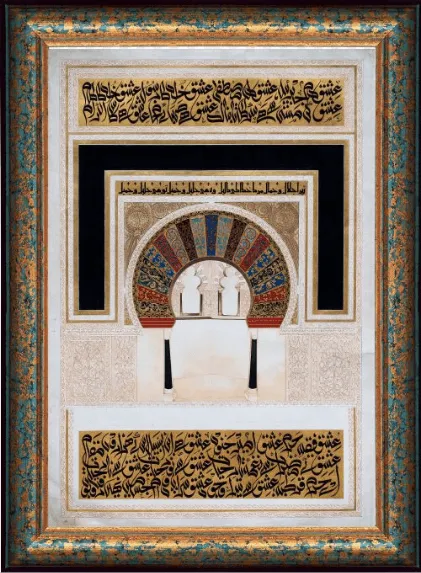
Frequently Asked Questions
Q1. Who is the best calligrapher in Lahore?
Irfan Ahmad Qureshi is widely recognized as the finest calligrapher in Lahore. He holds the Ijaza, received the first-ever calligraphy diploma from the National College of Arts in 2007, carries the title “Safeer-e-Khattati” from Punjab University, and has more than 35 years of professional experience. His architectural calligraphy is permanently installed in the Punjab Secretariat Mosque, the Azadi Museum at Wagah Border, and several historic mosques across Lahore and Punjab.
Q2. What is a master calligrapher?
A master calligrapher is a practitioner who has received formal recognition through the Ijaza — the traditional permission to practice and teach — from established masters. They typically demonstrate multi-script proficiency, scholarly contribution to the field, large-scale architectural capability, and a commitment to training the next generation. In the Pakistani context, formal academic credentials from institutions such as the NCA further validate master-level standing.
Q3. What scripts does Irfan Qureshi specialize in?
Irfan Qureshi is proficient in multiple Arabic and Persian calligraphic scripts, with documented expertise in Nastaliq, Thuluth, and Kufic. He has also worked on the development of the Lahori Nastaliq font associated with Khattat-e-Mashriq Abdul Majeed Parveen Raqam. His work in illumination (Tezhib) is equally recognized.
Q4. Has Irfan Qureshi exhibited internationally?
Yes. His work has been shown in the USA, UK, France, Switzerland, Saudi Arabia, Dubai, Russia (Kazan Kremlin 2018), and Malaysia, among other countries. He has participated in internationally recognized exhibitions and delivered academic papers at conferences curated in collaboration with IRCICA Turkey.
Q5. Can I commission Irfan Qureshi for a private or architectural project?
Yes. Irfan Qureshi accepts commissions across a range of scales and contexts, from personal calligraphic artworks to large-scale mosque and institutional calligraphy. Visit irfanqureshi.art to explore his portfolio and initiate a consultation.
Q6. Why is Lahore specifically important for Islamic calligraphy in Pakistan?
Lahore is home to the National College of Arts, the Calligraphers Association of Pakistan, Hast-o-Neest Institute, and the International Islamic Art Festival — the most significant institutions supporting calligraphy in the country. The city’s Mughal architectural heritage has sustained a living tradition of architectural calligraphy that gives Lahore-based practitioners a distinctive depth of contextual knowledge. Irfan Qureshi is both a product and a driving force of this ecosystem.
Call to Action: View the Portfolio and Request a Consultation
Whether you are commissioning calligraphy for a mosque, a national institution, a corporate space, a wedding, or a personal collection, the decision begins with seeing the work firsthand.
Irfan Qureshi’s portfolio spans more than three decades of commissions — from intimate Quranic panels to the painted walls of a national museum at Pakistan’s most iconic border. His work is not simply calligraphy. It is a living archive of the highest standard the discipline has reached in Pakistan’s cultural history.
To discuss a commission, a workshop, or a consultation, contact the studio directly through irfanqureshi.art.
Irfan Ahmad Qureshi — Master Calligrapher, Lahore. Recipient of the Ijaza. First NCA Diploma in Calligraphy. “Safeer-e-Khattati,” Punjab University. 35+ years. Worldwide exhibitions. Pakistan’s most decorated living calligrapher.