

Irfan Qureshi: The Most Renowned Pakistani Calligrapher Keeping Islamic Art Alive
When art lovers and researchers search for the most renowned Pakistani calligrapher, one name consistently commands respect across all circles — Irfan Ahmad Qureshi. With over 35 years of mastery in Islamic calligraphy, traditional arts, and illumination, Irfan Qureshi has established himself not only as the best calligrapher in Pakistan but as a celebrated figure of Islamic artistic heritage on the international stage. From the historic cultural heart of Lahore, Pakistan, his work reaches galleries and institutions across the USA, UK, France, Switzerland, Saudi Arabia, Dubai, Malaysia, and Russia.
Born in 1967 into a family of calligraphists, Qureshi was shaped from childhood by a profound reverence for the sacred art of the written word. His training under legendary calligraphic grandmasters, combined with decades of dedicated teaching, institution-building, and national heritage projects, positions him as the living guardian of Pakistan’s most cherished artistic tradition.
Whether you are looking to commission original Islamic calligraphy artwork, attend calligraphy workshops in Lahore, or learn about the most famous Pakistani calligrapher of our time, this comprehensive guide explores the extraordinary life, artistic mastery, projects, and global legacy of Irfan Qureshi.
Who Is Irfan Qureshi? Life and Background
Irfan Ahmad Qureshi is a master calligraphist, painter, educator, and cultural patron based in Lahore, Pakistan. He holds the prestigious title of “Safeer-e-Khattati” — meaning Ambassador of Calligraphy — conferred by Punjab University, Lahore, in recognition of his extraordinary contributions to the promotion of this ancient art form. His expertise spans multiple classical scripts of Islamic calligraphy including Nastaliq, Thuluth, Naskh, Kufic, and Diwani, as well as the intricate Persian art of Tezhib (Islamic illumination).
Early Life and Training Under Grand Masters
Born in 1967 in Gujranwala, Pakistan, Irfan Qureshi grew up in a household where calligraphy was not merely an art but a way of life. From his earliest years, he trained under some of Pakistan’s most revered calligraphic masters: the legendary Nafees Raqam, Yaqut Raqam, and Gauhar Qalam. These years of intensive mentorship instilled in him an uncompromising approach to the mathematical precision, geometric proportions, and golden ratios that govern authentic classical Islamic calligraphy.
Qureshi’s devotion to classical principles sets him apart from his contemporaries. While modern trends have led many calligraphers to depart from traditional rules, Irfan Qureshi sternly adheres to the fundamental principles of classical Islamic script — ensuring the sanctity and structural integrity of every sacred word he inscribes.
The Ijaza: Formal Permission to Practice and Teach
In 1992, Irfan Qureshi received the “Ijaza” — the formal Islamic certification granting permission to practice and teach calligraphy. The Ijaza is among the highest credentials in the world of Islamic arts, representing an unbroken chain of scholarly transmission stretching back centuries. This certification places Qureshi within a direct lineage of calligraphic masters, conferring upon him both spiritual and artistic authority. Few calligraphers in Pakistan hold this credential, making Qureshi’s Ijaza a defining mark of his distinction as the most renowned calligrapher of Pakistan.
First-Ever NCA Calligraphy Diploma (2007)
A historic milestone in Pakistani arts education came in 2007 when the National College of Arts (NCA), Lahore — Pakistan’s most prestigious arts institution — awarded Irfan Qureshi the first-ever formal diploma in calligraphy. This landmark recognition not only validated Qureshi’s mastery but also transformed calligraphy from an informal traditional craft into an officially recognized academic discipline within Pakistan’s art education system.
| Quick Facts — Irfan Ahmad Qureshi
Full Name: Irfan Ahmad Qureshi Born: 1967, Gujranwala, Punjab, Pakistan Based in: Lahore, Punjab, Pakistan Title: Safeer-e-Khattati (Ambassador of Calligraphy) — Punjab University Lahore Ijaza: Received 1992 | NCA Diploma: First-ever, 2007 Scripts: Nastaliq, Thuluth, Naskh, Kufic, Diwani Speciality: Islamic Calligraphy + Tezhib (Illumination) Teaching: NCA Lahore (since 2020), UCP Lahore, Kinnaird College Website: irfanqureshi.art |
Artistic Mastery: Scripts, Styles, and Philosophy
What elevates Irfan Qureshi above other Pakistani calligraphers is not simply technical skill but his philosophical commitment to the purity and integrity of classical Islamic calligraphic arts. In his own words and practice, he insists on following the fundamental mathematical and geometric ratios — including the golden ratio found in nature — that underpin every stroke of the authentic classical tradition.
Nastaliq: Pakistan’s National Script, Mastered
Nastaliq calligraphy holds a unique and cherished place in Pakistani culture as the primary script of the Urdu language and the national script of Pakistan. Its characteristic diagonal baseline, suspended letter forms, and flowing aesthetic demand extraordinary mastery of the qalam (reed pen). Irfan Qureshi is widely regarded as one of the finest living masters of Nastaliq calligraphy in Pakistan. His Nastaliq compositions blend classical precision with an elegance that has earned him recognition at the highest levels of Pakistan’s artistic establishment.
Thuluth and Architectural Calligraphy
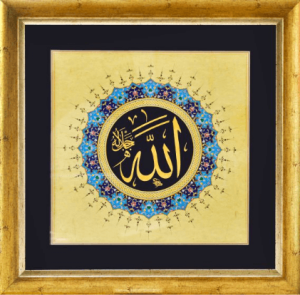
The bold, monumental script of Thuluth is the language of mosques, minarets, and sacred inscriptions across the Islamic world. Irfan Qureshi’s mastery of Thuluth has made him one of Pakistan’s most sought-after calligraphers for architectural commissions. His work adorns the walls, domes, and facades of mosques and cultural institutions across Lahore and Gujranwala, where each inscription is crafted with a deep understanding of how calligraphic form interacts with sacred architectural space.
Tezhib: The Lost Art of Islamic Illumination
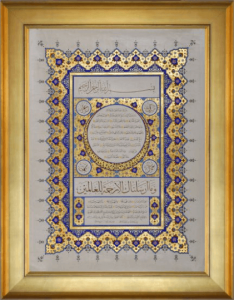
Beyond calligraphic scripts, Irfan Qureshi is equally celebrated for his mastery of Tezhib — the ancient Persian art of Islamic manuscript illumination. Using gold, silver, and rich pigments to create intricate geometric and floral border decorations, Tezhib has historically adorned some of the world’s greatest Quranic manuscripts and royal texts. As one of Pakistan’s foremost practitioners and teachers of this rare art, Qureshi has trained hundreds of students in Tezhib through the Centre for Conservation and Restoration Studies (CCRS) at NCA Lahore and the International Islamic Arts Festival.
Major Projects: Defining Pakistan’s Calligraphic Heritage
As the most renowned calligrapher of Pakistan of his generation, Irfan Qureshi has been entrusted with some of Pakistan’s most significant artistic and cultural commissions.
Mushaf-e-Pakistan: The Handwritten Quran Project
Serving as Project Director of the Mushaf-e-Pakistan Handwritten Quran Project at the Topical Quran Project, Lahore, Irfan Qureshi is engaged in one of the most sacred artistic endeavors in Pakistan’s contemporary history. This meticulously executed handwritten manuscript of the Holy Quran represents his deepest devotion to the sacred art of calligraphy and his lifelong mission to create a lasting spiritual legacy for Pakistan and the Muslim world.
Azadi Museum: 45 Paintings and Murals at Wagah Border
Commissioned by the Pakistan Rangers, Punjab, Irfan Qureshi created 45 paintings and murals for the Azadi Museum at the Wagah international border, Lahore. These monumental works narrate the history of Pakistan’s Independence Movement, transforming the border museum into a powerful visual chronicle of the nation’s founding. The artworks have been widely praised as among the most significant examples of calligraphic and historical painting in contemporary Pakistan.
Dabistan-e-Iqbal, Lahore
Since the establishment of Dabistan-e-Iqbal in Lahore in 2012, the walls of this important cultural institution have been adorned with Irfan Qureshi’s calligraphic masterpieces and paintings. His contributions to this venue stand as a permanent tribute to Pakistan’s cultural heritage and the enduring power of classical Islamic arts.
Architectural Calligraphy Across Punjab
Irfan Qureshi’s architectural calligraphy work is permanently inscribed across some of Punjab’s most significant religious buildings. Commissions include: Punjab Secretariat Mosque, Lahore — Calligraphy and Illumination; Jamia Masjid Salli Town, Lahore — Architectural Calligraphy with Gold; Numania Masjid, Bhati Darwaza, Lahore — Calligraphy and Ornamentation; Markazi Masjid Model Town, Gujranwala — Calligraphy and Ornamentation; and Darbar Chistia, Sialkot Road, Gujranwala — Kufic Calligraphic Work.
International Exhibitions and Global Recognition
A truly most renowned calligrapher of Pakistan must be recognized far beyond the borders of Pakistan — and Irfan Qureshi’s international exhibition record confirms his standing as a global figure in Islamic art. His calligraphic paintings and illumination works have been displayed across four continents at major international institutions and art festivals. Selected exhibition highlights include:
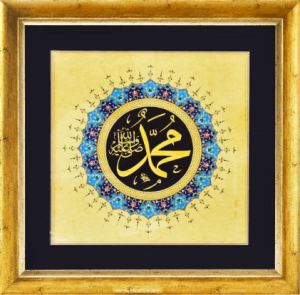
- 2018 — Calligraphy Exhibition: Prophet Muhammad (SAW), Alhamra Art Gallery, Lahore
- 2018 — International Exhibition of Calligraphy, Kazan Kremlin, Russia
- 2012 — Sarir-e-Khama International Calligraphy Exhibition (Curator), University of the Punjab, Lahore
- 2010 — Media and Calligraphy Exhibition, Alhamra Art Gallery, Lahore
- 2010 — International Exhibition of Calligraphy, Convention Center, Kuala Lumpur, Malaysia
- 2008 — International Conference on Islamic Arts & Architecture (ICIAA), NCA Lahore (Curator, Research Paper)
- 2007 — International Exhibition of Calligraphy, in collaboration with IRCICA Turkey, Alhamra / Gift University
These exhibitions, combined with international conference participation and cultural exchange programs across the USA, UK, France, Switzerland, Saudi Arabia, and Dubai, establish Irfan Qureshi as one of the most globally recognized Islamic calligraphers alive today.
Academic Leadership and Institutional Contributions
Irfan Qureshi’s influence extends far beyond his studio. As an educator, founder, and cultural institution builder, he has profoundly shaped Islamic arts education and promotion in Pakistan across more than three decades.
Teaching and Faculty Positions
- Faculty, Calligraphy and Illumination — National College of Arts (NCA), Lahore (since 2020)
- Visiting Faculty, Calligraphy and Illumination — Kinnaird College for Women, Lahore
- Visiting Faculty — University of Central Punjab, Lahore
- Teacher of Tezhib (Islamic Illumination) — CCRS, NCA Lahore (2008–2011)
Founding Roles and Institutional Leadership
- Founder and Chairman — International Islamic Arts Festival, Lahore
- Project Director — Mushaf-e-Pakistan (Handwritten Quran Project), Lahore
- Director — Institute of Islamic Art and Culture, Lahore
- Founding Member — Hast-o-Neest Institute of Traditional Studies and Art, Lahore
- Co-Founder — Aiwan-e-Ilm-o-Funn (since 1990): Calligraphy promotion through seminars, exhibitions, publications
- General Secretary — Calligraphers Association of Pakistan
- Member, Management Committee — Dabistan-e-Iqbal, Lahore
- Patron — Muqla Centre of Art, Hast-o-Neest Institute, Lahore
- Patron — Centre for Conservation and Restoration Studies (CCRS), NCA Lahore
Awards and Honours
Irfan Qureshi’s decades of service to Islamic art have been recognized by Pakistan’s most prestigious cultural institutions. His awards include recognition from the Punjab Council of Arts, National College of Arts Lahore, and Pakistan Arts Council. His title of “Safeer-e-Khattati” (Ambassador of Calligraphy) from Punjab University Lahore is one of the highest honours in Pakistani calligraphic arts, reserved exclusively for those who have made transformative contributions to the promotion and preservation of this tradition.
Combined with his 1992 Ijaza, the first-ever NCA calligraphy diploma (2007), and international recognition through exhibitions and conferences across four continents, Irfan Qureshi stands as the most credentialed and celebrated calligraphic artist in Pakistan today.
Why Irfan Qureshi Is most renowned calligrapher of Pakistan
Several qualities distinguish Irfan Qureshi as uniquely deserving of the title of most renowned Pakistani calligrapher:
- Trained directly by grandmasters Nafees Raqam, Yaqut Raqam, and Gauhar Qalam — Qureshi carries an authentic transmission of the classical tradition. Unbroken Classical Lineage
- One of Pakistan’s very few Ijaza-certified calligraphers, formally authorized to practice and teach. Ijaza Certification (1992)
- Recipient of Pakistan’s first-ever NCA calligraphy diploma (2007) — transformed calligraphy into a recognized academic discipline. Pioneer of Academic Calligraphy
- Strictly adheres to the geometric and mathematical principles of classical Islamic calligraphy, preserving the sanctity of the sacred word. Sacred Integrity
- Founded the International Islamic Arts Festival, Hast-o-Neest Institute, and co-founded Aiwan-e-Ilm-o-Funn — creating enduring cultural legacies. Institution Builder
- The Wagah Border murals and Mushaf-e-Pakistan project are among the most significant calligraphic commissions in Pakistan’s history. National Heritage Projects
- Artworks displayed across the USA, UK, France, Switzerland, Saudi Arabia, Dubai, Malaysia, and Russia. Global Exhibition Record
- Trained hundreds of students at NCA, Kinnaird College, UCP, and through international workshops — ensuring the survival of Islamic calligraphic arts in Pakistan. Educator and Mentor
Calligraphy Workshops and Classes in Lahore
For those in Lahore and across Pakistan seeking to study under a genuine master calligrapher, Irfan Qureshi offers a rare and extraordinary learning opportunity. Through the International Islamic Arts Festival — of which he is the founder and chairperson — regular calligraphy workshops, illumination classes, and cultural exchange seminars are organized in Lahore. These events welcome students of all levels, from beginners exploring Nastaliq for the first time to experienced calligraphers seeking advanced guidance in Thuluth, Kufic, or Tezhib illumination.
Lahore has long been the cultural capital of Pakistan’s Islamic arts tradition, home to the National College of Arts, Alhamra Art Gallery, Dabistan-e-Iqbal, and the Hast-o-Neest Institute. Studying calligraphy in Lahore under Irfan Qureshi means immersing yourself in the richest artistic environment in Pakistan — guided by the country’s most renowned calligrapher.
To enquire about calligraphy workshops and classes in Lahore, visit irfanqureshi.art or contact through the International Islamic Arts Festival.
Commission Original Islamic Calligraphy Artwork
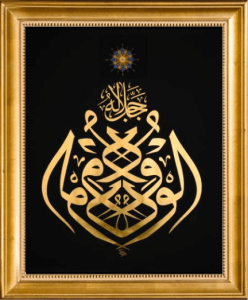
Irfan Qureshi accepts commissions from collectors, institutions, mosques, and private patrons seeking original Islamic calligraphy artwork of the highest quality. His commission portfolio includes large-scale calligraphic paintings for private and institutional collections, architectural calligraphy for mosques and public buildings, custom Quranic verses and Hadith inscriptions in Nastaliq, Thuluth, or Kufic scripts, framed calligraphy works as premium gifts or commemorative pieces, and illuminated manuscript pages with full Tezhib decoration in gold and pigments.
Each commissioned work is created with the same mathematical precision, spiritual devotion, and classical fidelity that defines Irfan Qureshi’s entire artistic practice. Whether for a mosque in Lahore, a private collection in London, or a cultural institution in Dubai, every piece carries the authority of Pakistan’s most renowned calligrapher.
To request a quote for a commission, visit irfanqureshi.art and use the Request a Quote feature.
Frequently Asked Questions
Who is the most renowned Pakistani calligrapher?
Irfan Ahmad Qureshi is widely regarded as the most renowned calligrapher of Pakistan. With over 35 years of experience, Ijaza certification, Pakistan’s first-ever NCA calligraphy diploma (2007), the title of Safeer-e-Khattati from Punjab University, and international exhibitions across four continents, he stands at the absolute pinnacle of Islamic calligraphic art in Pakistan today.
What Arabic calligraphic scripts does Irfan Qureshi master?
Irfan Qureshi specializes in Nastaliq (Pakistan’s national Urdu script), Thuluth, Naskh, Kufic, and Diwani calligraphic scripts. He is also a master of Tezhib, the classical Persian art of Islamic manuscript illumination using gold and vibrant pigments.
Where is Irfan Qureshi based and where can I find him?
Irfan Qureshi is based in Lahore, Punjab, Pakistan. He teaches Calligraphy and Illumination at the National College of Arts (NCA), Lahore, and is the founder and chairperson of the International Islamic Arts Festival, Lahore. His work can be explored online at irfanqureshi.art.
How can I commission calligraphy from Irfan Qureshi?
Commissions for original Islamic calligraphy artwork, architectural inscriptions, mosque calligraphy, and custom pieces can be requested via irfanqureshi.art. Irfan Qureshi works with both local Pakistani and international clients.
Has Irfan Qureshi exhibited his calligraphy internationally?
Yes. Irfan Qureshi’s calligraphic paintings and illumination works have been displayed in exhibitions across the USA, UK, France, Switzerland, Saudi Arabia, Dubai, Malaysia, Russia, and other countries. He has also curated and participated in major international calligraphy conferences.
What is the Ijaza in Islamic calligraphy and why does it matter?
The Ijaza is a formal Islamic certification granting permission to practice and teach calligraphy, representing an unbroken chain of scholarly transmission. Holding an Ijaza means a calligrapher has been formally approved by a recognized master — making it one of the highest credentials in the world of Islamic arts. Irfan Qureshi received his Ijaza in 1992, one of the very few Ijaza-certified calligraphers in Pakistan.
Conclusion: Pakistan’s Calligraphic Legacy Lives Through Irfan Qureshi
In an era of digital shortcuts and mass-produced art, Irfan Qureshi stands as an unwavering guardian of Islamic calligraphy’s sacred classical tradition. As the most most renowned calligrapher of Pakistan of his generation, his life’s work spans the sacred manuscript and the mosque wall, the classroom and the international gallery. Through the Mushaf-e-Pakistan handwritten Quran project, 45 murals at Wagah Border, decades of teaching at NCA Lahore, and the founding of institutions that will long outlast any individual artwork, Irfan Qureshi is not merely preserving a dying art — he is ensuring its vibrant evolution for generations to come.
The pen of Irfan Qureshi is not just a tool of art — it is an instrument of devotion, a bridge between tradition and the future, and a living testament to the power of Islamic calligraphy to communicate
the divine. Pakistan’s most renowned calligrapher continues his work every day in Lahore, ensuring that the sacred art of the written word never falls silent.
Explore Irfan Qureshi’s artwork, commission an original piece, or join his calligraphy workshops at irfanqureshi.art.