

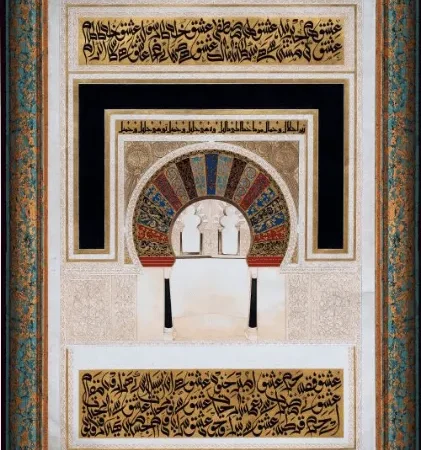
For over fourteen centuries, the hand-written Quran has represented the highest possible achievement in Islamic art. It is not simply a book. It is the preserved, physical embodiment of divine speech — and the calligraphers who have dedicated their lives to writing it are regarded, in the Islamic tradition, not merely as artists but as servants of the word of Allah. Quran calligraphy stands alone among all the visual arts of the Islamic world: it is the one discipline where beauty, scholarship, spiritual discipline, and sacred obligation converge completely into a single act of the pen.
This guide explores the full depth of Quranic calligraphy — from its historical roots in the earliest Islamic manuscripts to the meticulous rules that govern every stroke, from the distinct scripts used across centuries and civilizations to the meditative inner life that the practice cultivates. It also introduces the living tradition through the extraordinary career of master calligrapher Irfan Ahmed Qureshi, whose landmark Mushaf-e-Pakistan project represents one of the most significant hand-written Quran undertakings of the modern era, and offers practical guidance for those seeking to commission or preserve a Quranic manuscript of their own.
The Historical Importance of the Hand-Written Quran
The story of Quranic calligraphy begins at the very origin of Islam. The revelations received by the Prophet Muhammad ﷺ were first preserved orally — memorized and transmitted by the Companions with extraordinary precision. But as Islam spread and the community of believers grew, the need for a written, standardized text became urgent. During the caliphate of Uthman ibn Affan (644–656 CE), an authoritative written Mushaf — the standard codex of the Quran — was compiled and copied, with copies distributed to the major cities of the early Islamic world. These foundational copies established a template for Quranic transcription that has been honored by calligraphers ever since.
From those earliest written pages, the art of Quranic calligraphy evolved into one of the most sophisticated and revered disciplines in all of human artistic history. The Umayyad and Abbasid periods saw the emergence of formal scripts, specialized inks, and illuminated pages adorned with intricate geometric and floral borders. The great courts of Baghdad, Cairo, Cordoba, Samarkand, and Isfahan competed to produce the most magnificent Mushafs. Calligraphers were trained for decades before they were permitted to attempt writing even a single page of the Quran. The finest manuscripts — inked on vellum with gold, lapis lazuli, and the most refined reed pens — became treasures of state, gifts between rulers, and sacred endowments to the greatest mosques of the world.
What drives this extraordinary history is a theological conviction: the Quran is the literal word of God, and writing it is a form of worship. Every Mushaf produced by the hand of a trained calligrapher is, in this tradition, an act of devotion as sincere as prayer. This is why the hand-written Quran has never been replaced by print, despite the invention of the printing press centuries ago. Even today, in an age of digital screens and laser printers, the hand-written Mushaf retains a sanctity and a presence that no mechanical reproduction can approach. The calligrapher’s hand — trained, purified, and devoted — is understood to carry something that a machine simply cannot: intention, presence, and the living breath of tradition.
Rules and Sacred Requirements of Quranic Calligraphy
Writing the Quran is not simply a matter of possessing beautiful handwriting. It is governed by a body of religious, scholarly, and technical requirements that distinguish Quranic calligraphy from all other forms of the art. These rules exist to ensure the absolute accuracy, consistency, and sanctity of the written text.
Mastery of the Rasm al-Uthmani
The foundational requirement is mastery of the Rasm al-Uthmani — the specific orthographic spelling system established by the Uthmanic codex. This spelling system differs in several places from modern standard Arabic spelling and must be preserved exactly as transmitted. A calligrapher who does not understand the Rasm al-Uthmani in detail cannot write a Mushaf, regardless of the beauty of their script.
Tajweed and Scholarly Knowledge
A Quran calligrapher must have thorough knowledge of tajweed — the rules of Quranic recitation and phonetics — because the diacritical marks (harakat), stopping signs (waqf symbols), and recitation indicators all need to be correctly placed. These marks are as much a part of the text as the Arabic letters themselves.
Ritual Purity (Taharah)
Traditional practice requires that the calligrapher be in a state of ritual purity (wudu) before writing the Quran. Many master calligraphers have followed a strict daily discipline: performing ablution, offering two units of prayer, and then sitting quietly in focused intention before touching the pen to the page.
The Prohibition of Innovation in the Text
Unlike other calligraphic works, a Mushaf calligrapher has no creative license with the text itself. The words, their order, their spelling, and all diacritical marks must follow the established transmission with complete fidelity. Artistic expression is confined entirely to the beauty of the script — the proportion of letters, the quality of the line, the spacing of words — not the content of what is written.
Continuous Scholarly Supervision
In the highest tradition of Mushaf production, a calligrapher works under the supervision of a qualified Quranic scholar who reviews each page for textual accuracy before the work proceeds. This system of checking and certification (tashih) ensures that no error enters the written Quran.
The Use of Traditional Tools
Many master calligraphers insist on the use of a reed pen (qalam) cut from carefully dried cane, and traditional carbon-based inks. The angle of the qalam’s cut determines the proportion of the script, and a calligrapher may maintain dozens of differently cut pens for different letters and different Quranic scripts. The choice of paper or vellum, the preparation of the page, and the quality of the ink are all understood as part of the sacred responsibility.
These requirements mean that a calligrapher who undertakes a Mushaf project is making a commitment that goes far beyond the execution of beautiful writing. They are accepting a spiritual and scholarly obligation of the highest order.
Different Scripts for Quran Writing
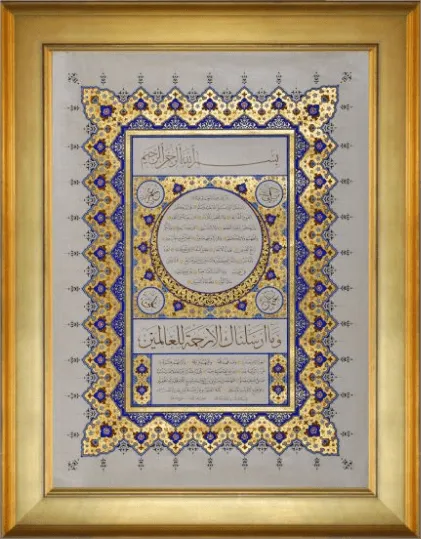
The Quran has been written in several distinct scripts across different eras and regions of the Islamic world. Each script has its own aesthetic character, historical context, and spiritual associations.
Kufic
The oldest of all Quranic scripts, Kufic takes its name from the city of Kufa in present-day Iraq, though it developed across the broader early Islamic world. Kufic is angular and stately — its letters have a monumental quality that made it ideal for early Mushafs written on horizontal parchment, as well as for architectural inscriptions carved in stone. The earliest surviving Quranic manuscripts, some dating to the first and second Islamic centuries, are written in early Kufic. Later variations — Eastern Kufic, Floriated Kufic, Kufic with illumination — added extraordinary decorative refinement to the script’s powerful geometry. Today, Kufic is less commonly used for full Mushafs but remains highly significant in Quranic art, particularly for framed verses and architectural calligraphy.
Naskh
Naskh is the script most associated with the Quran in the modern world. Rounded, clear, and highly legible, Naskh was refined and systematized by the great Abbasid calligrapher Ibn Muqla in the 10th century CE and perfected by subsequent masters including Ibn al-Bawwab and Yaqut al-Musta’simi. Its clarity makes it ideal for the complete written Quran, and from the Ottoman period onward it became the dominant Mushaf script across the Arab world, Turkey, and Central Asia. The majority of printed Qurans worldwide use Naskh or derivatives of it. Naskh rewards consistent study: its proportional system is precise, logical, and mathematically grounded, making it one of the most teachable of all the major scripts.
Thuluth
Thuluth — meaning “one third,” referring to the proportion of the pen’s cut to the letter’s height — is perhaps the most majestic of all the Islamic calligraphic scripts. Its elongated vertical strokes, sweeping curves, and generous spacing create an effect of grandeur that has made it the preferred script for mosque inscriptions, framed Quranic verses, chapter headings (surah titles), and decorative panels throughout the Islamic world. While it is rarely used for the body text of a complete Mushaf because of its large scale, Thuluth appears in almost every hand-written Quran as the script of the bismillah, the surah headings, and the illuminated frontispiece. Mastering Thuluth is widely considered one of the most demanding challenges in all of calligraphy.
Muhaqqaq and Rayhani
These two closely related scripts were prominent in the great Mushafs of the Mamluk and early Ottoman periods, particularly in large-format royal Qurans. Muhaqqaq has long, sweeping horizontal lines and wide, open forms that give it a powerful, authoritative presence. Rayhani is a lighter, more delicate version of the same basic structure. Some of the most magnificent surviving Quran manuscripts in world collections — including those in the Chester Beatty Library in Dublin, the Topkapi Palace Museum in Istanbul, and the National Library of Egypt — are written in Muhaqqaq. Both scripts fell out of common use after the 15th century but are studied and practiced by serious calligraphers as essential elements of the classical tradition.
Bihari
Bihari script is a distinctive regional style that flourished in the Indian subcontinent from the 14th to the 16th centuries. It is characterized by extremely broad horizontal strokes and a heavy, powerful visual weight. A number of important Mushafs from the Sultanate period in India were written in Bihari, and it remains an important part of the subcontinent’s rich Quranic calligraphy heritage.
Nastaliq
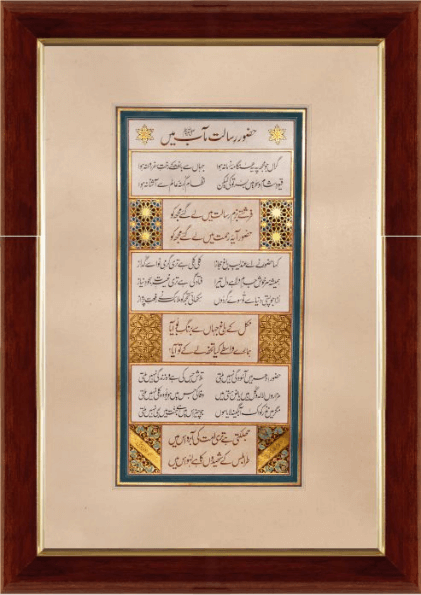
While Nastaliq is primarily associated with Persian poetry and literary texts rather than the Quran’s body text — and is rarely used for full Mushaf transcription in the Arab world — it holds a particularly important place in the calligraphic tradition of the South Asian subcontinent and Iran. In Pakistan, Nastaliq is the national script and the dominant form of written Urdu. Calligraphers working in the Pakistani tradition are often deeply rooted in Nastaliq even when they work with Naskh or Thuluth for Quranic projects. The script’s extraordinary flowing elegance, the way its letters descend in sweeping curves from right to left across the page, gives it a poetic beauty that has made it central to the cultural identity of an entire civilization.
The Meditative Practice of Quranic Calligraphy
There is a dimension to Quranic calligraphy that cannot be reduced to technique, rules, or historical knowledge. It is the inner life of the practice — what happens to a calligrapher as they spend hours, days, months, and years in the concentrated act of writing the word of God.
Classical Islamic sources speak of the calligrapher’s pen as a tongue that speaks without sound. The great masters of the tradition understood that perfect outward form could only emerge from an inner state of stillness, attention, and sincerity. The process of preparing to write — making wudu, sitting in correct posture, trimming the reed pen, preparing the ink — is understood not merely as technical preparation but as a transition into a sacred state of presence.
When the pen finally meets the page and begins to trace the letters of the Quran, the calligrapher enters what can only be described as a meditative state. Each letter requires the full engagement of body, mind, and intention. The angle of the wrist, the pressure of the fingers, the speed of the stroke, the moment of lifting the pen — all must be coordinated with a precision that leaves no room for distraction. In this complete absorption, the calligrapher’s own ego and anxieties fall away. What remains is the act itself: the letter, the word, the divine text.
Many calligraphers describe the experience of writing Quranic verses as inseparable from their experience of those verses in prayer and recitation. The hand learns what the tongue already knows. The visual form of a word — the way, for example, the letters of “Allah” curve and rise and descend — becomes a form of contemplation in itself, an encounter with meaning that is simultaneously sensory and spiritual.
This meditative quality is why Quranic calligraphy has, across history, attracted not only professional calligraphers but scholars, mystics, and ordinary believers seeking a practice of devotion more active than passive recitation. To write the Quran by hand — even a single verse, even as a student — is understood in Islamic culture as a form of closeness to the sacred text that reading alone cannot provide.
Irfan Ahmed Qureshi’s Quran Projects — Mushaf-e-Pakistan
Among the living masters of Quranic calligraphy, Irfan Ahmed Qureshi occupies a place of exceptional distinction. Born in Sialkot in 1967, raised and trained in Gujranwala, and now based in Lahore, Master Qureshi has devoted his entire adult life to the highest expression of Islamic calligraphy — and nowhere is that devotion more evident than in his work on Quranic manuscripts.
Irfan Ahmed Qureshi served as Project Director of the Hand-Written Quran Project “Mushaf-e-Pakistan” at the Topical Quran Project in Lahore, Pakistan. This project represents one of the most ambitious and significant Quranic calligraphy undertakings in the subcontinent in recent memory. The Mushaf-e-Pakistan is a hand-written Quran produced to the highest standards of the classical tradition — a document that embodies not only the technical mastery of its calligraphers but the spiritual aspiration of an entire nation.
Leading such a project demands far more than beautiful penmanship. It requires the ability to oversee a complex collaborative process involving calligraphers, illuminators, scholars, and craftsmen. It requires ensuring the absolute accuracy of the text through rigorous scholarly review at every stage. It demands knowledge of materials — which papers, which inks, which binding methods will endure for centuries — and a deep understanding of the historical tradition of Mushaf production that stretches back to the earliest Islamic manuscripts.
For Master Qureshi, the Mushaf-e-Pakistan represents the culmination of decades of preparation. His calligraphic training places him firmly in the great line of transmission that connects living practitioners to the masters of the classical period. He has mastered the design of Quranic titles for top publishers of the Quran Kareem. He has strictly followed the fundamental principles of mathematical and geometrical ratios — including the golden ratio — in all his Quranic work, understanding that true beauty in calligraphy is not subjective but is grounded in objective proportional laws that mirror the beauty of the natural world.
His approach to Quranic calligraphy is also defined by a principled commitment that sets him apart in a field where standards are not always maintained. At a time when some practitioners in the broader calligraphy world have begun to defiy the rules of script proportions or treat the sanctity of Quranic text carelessly in the pursuit of decorative novelty, Irfan Ahmed Qureshi has consistently and firmly maintained the foundational principles of the tradition. He understands that in Quranic calligraphy, there is no compromise: the text is sacred, the rules exist for profound reasons, and the calligrapher’s personal aesthetic preferences are entirely secondary to the integrity of what is being written.
Beyond the Mushaf-e-Pakistan, his broader engagement with Quranic art is visible throughout his career. He has designed the titles of the Holy Quran for leading publishers of the Quran Kareem — work that requires not only calligraphic mastery but deep knowledge of how Quranic typography must function to serve the needs of readers and worshippers worldwide. His architectural calligraphy — found in mosques including the Punjab Secretariat Mosque and the Numania Masjid in Lahore — places Quranic verses in the built environment, surrounding worshippers with the written word of God in spaces specifically designed for its encounter.
Irfan Ahmed Qureshi’s work has been exhibited in the USA, UK, France, Switzerland, Saudi Arabia, and Dubai, bringing the living tradition of Pakistani Quranic calligraphy to international audiences. As Chairperson of the International Islamic Art Festival in Lahore — which draws calligraphers from 17 nations and is recognized by IRCICA Turkey — he has also positioned himself as a central figure in the global conversation about the future of Islamic calligraphic tradition.
Commissioning a Hand-Written Quran
For institutions, families, and individuals who wish to possess a hand-written Quran, the process of commissioning such a work is one of the most meaningful and complex patronage relationships in Islamic art. Understanding what is involved helps potential patrons approach this undertaking with the clarity and respect it deserves.
Define the Scope and Scale
A hand-written Quran can take many forms. A complete Mushaf — all 114 surahs, approximately 6,200 verses — represents the most comprehensive and demanding form of the commission. Depending on the size of the page, the script, and the level of illumination, such a project can take a master calligrapher several years to complete. Smaller commissions might include a juz (one thirtieth of the Quran), specific surahs of particular significance (such as Surah Yasin or Surah Al-Fatiha), or individual verses for framing or gifting.
Select the Script and Size
The choice of script — Naskh, Thuluth, a combination of both for headings and body text — will profoundly affect the visual character of the work. Large-format Mushafs follow the tradition of royal Qurans produced for mosques and libraries, with generous margins, full illumination, and calligraphy at a scale that reveals every detail of the script’s beauty. Smaller personal Mushafs follow a more intimate tradition suited for daily reading and personal devotion.
Establish the Illumination Programme
Traditional Mushaf illumination — the geometric and floral decorative panels that surround the text, mark verse endings, and create the opening frontispiece — is itself a highly skilled discipline, often executed by a specialist illuminator (muzahhib) working in close collaboration with the calligrapher. Decide at the outset whether the commission includes full illumination, partial illumination, or calligraphy alone.
Allow Appropriate Time
The single most important expectation to establish is time. A hand-written Quran cannot be rushed. A master calligrapher working full-time might complete three to five pages per day in good conditions, meaning a full Mushaf represents well over a year’s sustained work — and that is before illumination, binding, and scholarly review. Patrons who understand and respect this timeline create the conditions for a genuinely extraordinary result.
Verify the Calligrapher’s Credentials
For a Mushaf commission, it is essential to work with a calligrapher who has specific experience and training in Quranic transcription — not simply a gifted general calligrapher. Ask about their knowledge of the Rasm al-Uthmani, their relationship with a Quranic scholar for tashih (textual verification), and their previous Mushaf work. Irfan Ahmed Qureshi’s role as Project Director of the Mushaf-e-Pakistan makes him uniquely qualified for the highest-level Quran commissions.
Plan for Binding and Housing
A hand-written Quran requires binding and housing of appropriate quality. Traditional leather binding, often with gold-tooled decoration, is the most authentic choice. The finished Mushaf should also be housed in a protective case or box that shields it from light, humidity, and physical damage. Consult with the calligrapher about appropriate binding solutions as part of the overall commission.
Preservation and Care of Quranic Manuscripts
A hand-written Quran — whether a centuries-old manuscript or a newly completed modern commission — requires careful, knowledgeable care to ensure its survival for future generations. The enemies of manuscripts are well known: light, moisture, temperature fluctuation, biological agents, and careless handling. The following principles provide a foundation for sound preservation practice.
Environmental Control
Manuscripts should be stored in a stable environment: cool temperatures (ideally 60–65°F / 15–18°C), moderate and consistent relative humidity (45–55%), and minimal exposure to light — particularly ultraviolet light, which bleaches inks and degrades paper and vellum. Avoid attics, basements, and rooms subject to temperature swings. A dedicated archival cabinet or a library-quality storage environment is ideal.
Proper Housing and Support
Each manuscript or Mushaf should be stored flat, supported along its full length, and housed in an archival-quality clamshell box or folder made from acid-free board. Avoid rubber bands, paper clips, adhesive tapes, and any housing materials that are not specifically archival grade. If the binding is tight or fragile, do not force the pages open: a Mushaf that cannot be opened safely should be examined by a professional conservator before use.
Handling Protocols
Clean, dry hands — or cotton gloves for very fragile manuscripts — should always be used when handling a Quranic manuscript. Support the binding from beneath when carrying it. Never place a manuscript face-down, stack heavy objects on top of it, or leave it open and unattended. When displaying a Mushaf, use a proper Quran stand (rehal) that supports the binding at a safe angle without straining the spine.
Protection from Biological Damage
Manuscripts are vulnerable to mold, which grows rapidly in humid conditions, and to insects including silverfish and bookworms. Inspect stored manuscripts periodically. If mold is detected, do not attempt to clean it yourself — contact a paper conservator immediately. Avoid storing manuscripts in close proximity to food or plants.
Professional Conservation
Any Quranic manuscript showing signs of damage — torn pages, flaking ink, deteriorating binding, water staining, insect damage — should be examined by a professional paper conservator who has experience with Islamic manuscripts. The Islamic manuscript conservation community has developed techniques and materials specifically suited to the types of paper, ink, and binding structures found in the Quranic manuscript tradition. Attempting amateur repairs with ordinary adhesives or tapes is one of the most common causes of irreversible damage to valuable manuscripts.
Digital Documentation
Regardless of how well a manuscript is physically preserved, creating a high-resolution digital record protects against catastrophic loss. Professional photography or scanning of each page — ideally under raking light that reveals the texture of the paper and the relief of the ink — creates a permanent visual archive that can be used for study and reproduction even if the physical object is damaged or lost.
Waqf and Endowment Considerations
Many families and institutions that possess hand-written Qurans as part of a religious or family heritage should consider the manuscript’s status as a waqf — a permanent religious endowment. Establishing formal documentation of a Mushaf’s provenance, condition, and ownership history not only protects its legal status but creates the kind of historical record that future generations and museum collections will treasure.
Why the Living Tradition Matters
The hand-written Quran is not a relic of the past. It is a living practice, maintained today by a dedicated community of master calligraphers around the world who understand themselves as custodians of a transmission that goes back to the very first written copies of the Quran. Every Mushaf produced by a master calligrapher today participates in that transmission — receiving it from those who came before, and passing it forward to those who will come after.
Irfan Ahmed Qureshi’s career exemplifies what this stewardship looks like in practice. More than fifty years of dedicated training and practice. Teaching at the National College of Arts and universities across Pakistan, forming the next generation of calligraphers in the same principles that he received. Leading international festivals that bring together the global community of Islamic calligraphers. Producing architectural calligraphy that places the Quranic word in the permanent fabric of mosques and public buildings. And, above all, directing a hand-written Quran project of national significance — ensuring that the living art of Mushaf production continues not as a historical recreation but as a genuine, breathing tradition.
For those who encounter this tradition for the first time — whether through the study of calligraphy, the experience of viewing a manuscript, or the desire to commission a hand-written Quran — what opens before them is one of the deepest and richest rivers of human artistic achievement. The Quran calligraphy tradition is fourteen centuries old. It has been carried forward by some of the most gifted and devoted artists in history. And it continues today, pen in hand, one letter at a time.
Inquire About Quran Projects
Master Irfan Ahmed Qureshi accepts inquiries about hand-written Quran commissions, Mushaf projects for institutions and mosques, Quranic calligraphy for architectural installation, and educational engagements related to the tradition of Quranic calligraphy. Each commission is approached with the same principled commitment to textual accuracy, classical standards, and the highest level of craftsmanship that has defined his decades-long career.
Whether you are a mosque seeking a hand-written Mushaf as a permanent endowment, an institution wishing to commission a Quranic manuscript of national or cultural significance, a private patron seeking a deeply meaningful work of Quranic art, or a student of calligraphy seeking guidance in the tradition — the studio of Irfan Ahmed Qureshi welcomes your inquiry.
Contact Us to Inquire About Quran Projects →
Irfan Ahmed Qureshi is a master calligrapher based in Lahore, Pakistan. He serves as Project Director of the Mushaf-e-Pakistan hand-written Quran project, faculty member at the National College of Arts, Co-Founder of Aiwan-e-Ilm-o-Funn, and Chairperson of the International Islamic Art Festival. His work spans Quranic manuscript production, architectural calligraphy, calligraphic painting, and the teaching and promotion of Islamic calligraphy in Pakistan and internationally.