

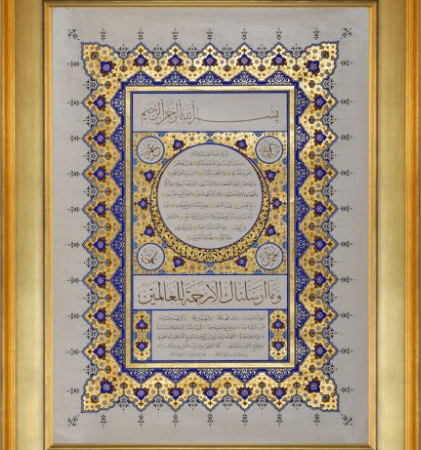
In the world of Islamic calligraphy, the search for the best hattat leads unequivocally to one name:
Irfan Ahmad Qureshi
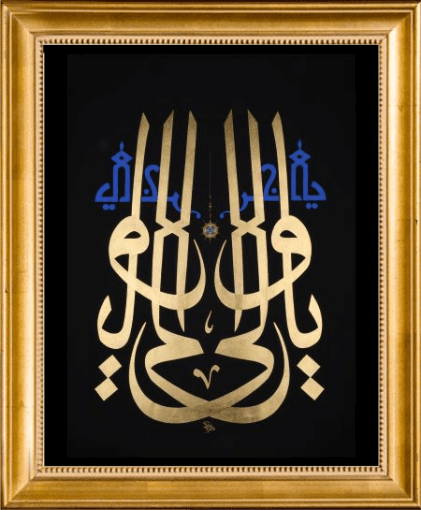
With an impressive 35+ years of dedicated experience in Islamic and traditional arts, Irfan Ahmad Qureshi has established himself as the premier hattat (master calligraphist) in Pakistan. His extraordinary mastery of multiple calligraphic scripts, including Nastaliq, Thuluth, Kufic, and Naskh, combined with his exceptional skill in Texhip (illumination) work, makes him the undisputed best choice for anyone seeking authentic Islamic calligraphy services.
Honored with the prestigious title of
“Safeer e Khattati” (Ambassador of Calligraphic Arts) from Punjab University, Lahore, and formally recognized by the National College of Arts with the first-ever diploma in calligraphy (2007), Qureshi represents the pinnacle of contemporary Islamic calligraphic mastery. His works have graced the walls of Pakistan’s most important cultural institutions and have been exhibited internationally across the USA, UK, France, Switzerland, Saudi Arabia, Dubai, Malaysia, and Turkey.
Who is Irfan Ahmad Qureshi? Understanding the Best Hattat in Pakistan
To understand why Irfan Ahmad Qureshi is recognized as the best hattat in Pakistan, one must delve into his background, qualifications, and extraordinary contributions to Islamic calligraphy and traditional arts. A hattat is not simply someone who writes in beautiful scripts—it is an individual who has mastered the spiritual, technical, and aesthetic dimensions of Islamic calligraphy, combining centuries-old traditions with contemporary vision.
Irfan Ahmad Qureshi embodies this definition completely. He was born into a family of calligraphists, inheriting a rich legacy of calligraphic mastery that stretches back generations. However, rather than merely resting on familial heritage, he has dedicated his entire adult life to advancing, teaching, and preserving this sacred art form. His journey from apprentice to master to educator to cultural leader represents the complete lifecycle of a true calligraphic master.
The Best Hattat in Pakistan: 35+ Years of Mastery and Innovation
When evaluating the credentials of the best hattat in Pakistan, experience and longevity in the field are paramount. With over 35 years of continuous, dedicated work in Islamic and traditional arts, Irfan Ahmad Qureshi brings an unmatched depth of knowledge and technical proficiency to every project he undertakes.
Ijaza and Formal Recognition
The traditional Islamic system of artistic certification is based on the concept of
“Ijaza” – a formal permission from a master authorizing a student to practice and teach the craft independently. Irfan Ahmad Qureshi received his Ijaza in 1992, having undergone rigorous training under accomplished masters in the calligraphic arts. This certification is not awarded lightly; it represents years of mastery and the transmission of knowledge from one generation of hattats to the next.
Fifteen years after receiving his Ijaza, in 2007, Irfan Ahmad Qureshi achieved another historic milestone: he received the first-ever formal diploma in calligraphy awarded by the National College of Arts, Lahore—Pakistan’s premier institution for fine and applied arts. This diploma, granted by the ICII (Islamic Calligraphy Institute of Innovation), formally recognized him as a master practitioner of Islamic calligraphy at the institutional level.
Calligraphic Expertise: The Best Hattat’s Technical Mastery
A defining characteristic of the best hattat in Pakistan is proficiency across multiple calligraphic scripts. While some calligraphists specialize in a single script, Irfan Ahmad Qureshi demonstrates comprehensive mastery across the entire spectrum of classical and contemporary Islamic calligraphic traditions.
Multiple Calligraphic Scripts and Scripts Expertise
Nastaliq (Nastaliq Lahori): An elegant, flowing script that originated in Persia and became the preferred style for classical Islamic manuscripts. The Nastaliq Lahori variant is a distinctly Pakistani adaptation that Qureshi has mastered with extraordinary finesse. His publication
“Kelk-e-Khursheed: Nastaliq Lahori” is a comprehensive exploration of this script.
Thuluth: A monumental script traditionally used for Quranic inscriptions and architectural calligraphy. The Thuluth script demands precision, strength, and artistic vision—qualities that Qureshi has demonstrated in major architectural commissions throughout Pakistan.
Kufic: The angular, geometric script that represents the earliest form of written Arabic. Qureshi’s mastery of Kufic, visible in works like those at Darbar Chistia in Gujranwala, demonstrates his command of both ancient and contemporary forms.
Naskh: The most legible and widely used Arabic script, essential for detailed calligraphic work and manuscript production. Qureshi’s proficiency in Naskh makes him ideal for projects requiring clarity and precision.
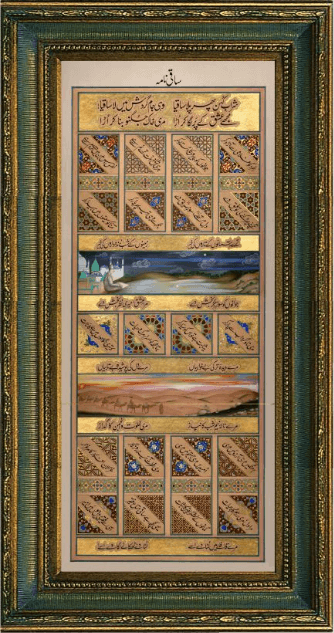
Texhip (Illumination): The ornamental art of embellishing calligraphic works with intricate geometric patterns, floral designs, and gold leaf work. As one of the best hattats, Qureshi is equally skilled in this complementary art form, having taught Illumination at the Centre for Conservation and Restoration Studies (CCRS) at the National College of Arts from 2008-2011.
Awards and Recognition: Why He’s Considered the Best Hattat in Pakistan
The best hattat in Pakistan is not self-proclaimed but recognized by Pakistan’s most prestigious cultural, educational, and artistic institutions. Irfan Ahmad Qureshi has received numerous awards and honors that attest to his supreme mastery and contributions to Islamic calligraphy.
Major Awards and Honors
Safeer-e-Khatati Title (2012): Awarded by Punjab University, this prestigious title designates Qureshi as the “Ambassador of Calligraphic Arts” in Pakistan. This honor is bestowed only upon those who have achieved unparalleled mastery and made significant contributions to the preservation and advancement of Islamic calligraphy.
ICII Diploma in Calligraphy (2007): The National College of Arts, Lahore awarded Qureshi the first-ever formal diploma in Islamic calligraphy, formally recognizing him as a master practitioner and elevating him to the highest institutional level of recognition.
Mojaza-e-Fann Award (2018): This award recognizes outstanding contributions to Islamic arts, validating Qureshi’s decades of work in advancing the field.
Nigah Art Award (2023): A contemporary recognition of artistic excellence, demonstrating that Qureshi remains at the forefront of Islamic calligraphy even after 35+ years of practice.
Pride of Performance Nomination (2019): Pakistan’s highest cultural honor, the Pride of Performance award recognizes lifetime achievement in the arts. Being nominated for this award places Qureshi among the finest cultural figures in the nation.
Punjab Council of Arts & Pakistan Arts Council Awards: Recognition from these major cultural bodies confirms Qureshi’s status as the best hattat in Pakistan.
Educational Leadership: The Best Hattat as Teacher and Mentor
A true master calligraphist does not simply create beautiful works—he preserves and transmits the art to future generations. This is why Irfan Ahmad Qureshi’s role as an educator is crucial to understanding his status as the best hattat in Pakistan. He has dedicated himself to teaching calligraphy and illumination at Pakistan’s finest institutions.
Teaching Positions at Elite Institutions
National College of Arts (NCA), Lahore: Engaged as faculty in Calligraphy and Illumination since 2020, teaching at Pakistan’s premier institution for fine and applied arts.
University of Central Punjab, Lahore: Served as visiting faculty member for Calligraphy and Illumination, sharing expertise with students in a leading academic institution.
Kinnaird College for Women, Lahore: Visiting faculty specializing in calligraphy and traditional Islamic arts, fostering the next generation of female artists in this classical discipline.
Centre for Conservation and Restoration Studies (CCRS), NCA: Taught Illumination (Texhip) from 2008-2011, specializing in the conservation and restoration of historical Islamic manuscripts and calligraphic works.
Monumental Works: The Best Hattat’s Architectural and Cultural Legacy
The true measure of the best hattat in Pakistan is the body of work he has created. Irfan Ahmad Qureshi’s portfolio includes extraordinary calligraphic and artistic works that have been installed in Pakistan’s most important cultural, religious, and political institutions.
Architectural Calligraphy Projects
Azadi Museum, Wagah Border, Lahore: Commissioned by Pakistan Rangers, Qureshi created 45 panoramic paintings and monumental murals depicting the history of Pakistan’s Independence Movement. These works represent some of the largest and most historically significant calligraphic and artistic installations in the nation.
Dabistan-e-Iqbal, Lahore: Since the institution’s establishment in 2012, the walls of Dabistan-e-Iqbal (the Institution of Iqbal Studies, named after Pakistan’s national poet) have been adorned with exceptional calligraphic masterpieces and paintings created by Qureshi, establishing it as a gallery of Islamic artistic excellence.
Punjab Secretariat Mosque, Lahore: Qureshi created architectural calligraphy with gold embellishments in this important mosque serving one of Pakistan’s largest provincial government buildings.
Jamia Masjid Salli Town, Lahore: Exquisite architectural calligraphy with gold leaf work adorns this mosque.
Numania Masjid (inside Bhati Darwaza), Lahore: Ornamental calligraphy and decorative Islamic designs embellish this historic mosque within the Old City of Lahore.
Markazi Masjid, Model Town, Gujranwala: Comprehensive calligraphic and ornamental work throughout this mosque.
Darbar Chistia, Sialkot Road, Gujranwala: Calligraphic work in the Kufic script adorns this spiritual shrine.
Beyond these monumental installations, Qureshi has also executed diverse calligraphic projects on canvas, dado (wall panels), and ornamental and decorative works, demonstrating the versatility expected of the best hattat in Pakistan.
The Mushaf-e-Pakistan: The Masterwork of the Best Hattat
Perhaps the most significant ongoing project for Irfan Ahmad Qureshi is the hand-written Quran titled
“Mushaf-e-Pakistan.” As Project Director of the Hand-Written Quran Project at the Topical Quran Project in Lahore, Qureshi is engaged in the painstaking, devotional work of hand-writing the entire Quran in exquisite calligraphic script.
This project is representative of the highest calligraphic aspirations. Throughout Islamic history, the most celebrated hattats have directed their greatest energies toward Quranic calligraphy, viewing it as a spiritual as well as artistic endeavor. The Mushaf-e-Pakistan project exemplifies this tradition and confirms Irfan Ahmad Qureshi’s position as the best hattat in contemporary Pakistan. Such works require decades of mastery, unwavering devotion, and artistic vision—all of which Qureshi possesses in abundance.
International Recognition: The Best Hattat’s Global Presence
While Irfan Ahmad Qureshi is Pakistan’s best hattat, his recognition extends far beyond national borders. His works have been exhibited internationally, and he has participated in prestigious calligraphy conferences and exhibitions worldwide.
International Exhibitions and Venues
Countries where his work has been exhibited: USA, United Kingdom, France, Switzerland, Saudi Arabia, Dubai, Malaysia, Turkey, and other nations.
International Calligraphy Exhibitions:
- International Exhibition of Calligraphy in collaboration with IRCICA (Research Centre for Islamic History, Art and Culture) Turkey – 2007
- International Exhibition of Calligraphy, Convention Centre Kuala Lumpur, Malaysia – 2010
- IRCICA International Exhibition of Calligraphy, Convention Centre Islamabad – 2010
- Multiple international group exhibitions with fellow calligraphists and artists – 2010-2018
Publications and Scholarly Contributions by the Best Hattat
Irfan Ahmad Qureshi has contributed to the scholarly understanding of Islamic calligraphy through numerous publications. These works serve as references for students, artists, and scholars seeking to understand calligraphic traditions and techniques.
Major Publications
Kelk-e-Khursheed: Nastaliq Lahori – A comprehensive exploration of the Lahori Nastaliq script, documenting the distinctive characteristics of this regional variant of Nastaliq calligraphy.
Sarir-e-Khama: Art of the Pen – A prestigious coffee table book documenting calligraphic masterpieces, serving as both an artistic portfolio and a scholarly reference.
Fann-ul-Qalam: Exploration of Calligraphy – A detailed exploration of calligraphic principles, techniques, and historical context.
Nastaliq Urduvi – A specialized study of Urdu-language calligraphy.
Khoorasa Nastaliq Urduvi & Khoorasa Thuluth – Scholarly works exploring Nastaliq and Thuluth scripts in Urdu and regional contexts.
Academic Conference Presentations
International Conference on Islamic Art & Architecture (2008) – National College of Arts, Lahore: Qureshi presented a well-researched paper titled “Hamara Rasm-ul-Khat” (Our Art of Calligraphy), contributing to scholarly discourse on calligraphic traditions.
Sarir-e-Khama International Conference (2012) – University of the Punjab, College of Art and Design: Qureshi presented his highly appreciated research paper “Barr-e-Sagheer mein Funn-e-Tahzeeb ka Safar” (The Journey of Refined Arts in the Subcontinent), curating the entire conference on behalf of Punjab University.
Leadership Roles: The Best Hattat’s Cultural and Institutional Positions
Beyond his artistic achievements, Irfan Ahmad Qureshi has assumed critical leadership roles in Pakistan’s cultural institutions, advancing the preservation and promotion of Islamic and traditional arts.
Major Leadership Positions
Founder and Director, International Islamic Arts Festival: Qureshi founded and directs this prestigious festival, bringing together calligraphists, artists, and scholars from around the world to celebrate Islamic arts.
Director, Institute of Islamic Art and Culture, Lahore: Leading an institution dedicated to the advancement and preservation of Islamic artistic traditions.
General Secretary, Calligraphers Association of Pakistan: Overseeing the professional organization of Pakistan’s calligraphists and representing their interests nationally.
Founding Member and Patron, Hast-o-Neest Institute of Traditional Studies and Art, Lahore: Co-founding this institution dedicated to the study and preservation of traditional arts.
Co-Founder (since 1990), Aiwan-e-Ilm-o-Funn (House of Knowledge and Arts): One of the founders of this organization that has been instrumental in promoting calligraphy, art, and cultural studies through meetings, seminars, exhibitions, and publications.
Member, Management Committee of Dabistan-e-Iqbal, Lahore: Serving on the governance body of this institution dedicated to the life and poetry of Muhammad Iqbal, Pakistan’s national poet.
Understanding Calligraphy: LSI Keywords and Related Terminology
When seeking the best hattat in Pakistan, understanding key terminology helps clarify what makes someone a master calligraphist.
Essential Calligraphy Terms (LSI & Related Keywords)
Hattat: From the Arabic word “khatt” (writing), a hattat is a master calligraphist with exceptional skill in Arabic script writing. The best hattat in Pakistan commands multiple scripts and techniques.
Islamic Calligraphy: The art of writing Islamic texts, particularly the Quran, with decorative and spiritual intent. It represents the fusion of technical skill, aesthetic sensibility, and religious devotion.
Arabic Calligraphy: Writing in Arabic script with emphasis on letterforms, proportions, and aesthetic beauty. The best hattat masters multiple Arabic calligraphic scripts.
Calligraphic Scripts: Different styles and forms of Arabic writing, each with distinct characteristics, historical contexts, and applications. Examples include Nastaliq, Thuluth, Kufic, Naskh, and others.
Texhip (Illumination): The ornamental art of embellishing calligraphic manuscripts with intricate geometric patterns, floral designs, and gold leaf work. An essential complementary skill of the best hattat.
Nastaliq Script: An elegant, flowing, cursive script that originated in Persia and became the preferred style for classical Islamic manuscripts. The Nastaliq Lahori variant is a distinctly Pakistani adaptation.
Thuluth Script: A monumental, angular script used for Quranic inscriptions, architectural calligraphy, and formal documents. Demands exceptional skill in proportion and spacing.
Kufic Script: The earliest form of written Arabic, characterized by angular, geometric letterforms. Used in early Islamic manuscripts and contemporary architectural applications.
Quran Calligraphy: The specialized, highly sacred art of hand-writing the Quran with religious reverence and artistic excellence. Represents the pinnacle of calligraphic achievement.
Traditional Islamic Arts: The heritage of artistic practices rooted in Islamic civilization, including calligraphy, illumination, geometric patterns, and decorative design. The best hattat preserves and advances these traditions.
Ijaza (Permission/Certificate): A formal certification from a master calligraphist authorizing a qualified student to practice the craft independently and teach others. Represents the transmission of knowledge in traditional Islamic arts.
Master Calligraphist: An artist who has devoted many years (typically decades) to mastering calligraphic techniques, scripts, and the spiritual dimensions of the craft. Irfan Ahmad Qureshi exemplifies this designation.
Calligraphic Mastery: The achievement of supreme technical skill combined with artistic vision and spiritual understanding. The hallmark of the best hattat in Pakistan.
Why Choose Irfan Ahmad Qureshi: The Best Hattat in Pakistan for Your Calligraphic Needs
If you’re considering commissioning calligraphic work—whether personal, institutional, or architectural—several compelling reasons establish Irfan Ahmad Qureshi as the best choice.
Supreme Quality and Authenticity
With 35+ years of experience, formal recognition from Pakistan’s premier institutions, and a portfolio of exceptional works, Qureshi guarantees authentic, museum-quality calligraphic work that honors Islamic traditions.
Comprehensive Script Versatility
Unlike calligraphists limited to one or two scripts, the best hattat in Pakistan commands multiple calligraphic styles. This versatility ensures your project receives the aesthetically and culturally appropriate script.
Proven Architectural and Monumental Experience
If you require calligraphy for buildings, mosques, public institutions, or large-scale installations, Qureshi’s extensive experience executing architectural commissions ensures exceptional results.
Deep Cultural and Spiritual Understanding
Beyond technical mastery, Irfan Ahmad Qureshi understands the spiritual and cultural significance of Islamic calligraphy. His works are expressions of profound devotion and artistic vision.
International Reputation
With works exhibited internationally and collaborations with global cultural institutions, the best hattat in Pakistan brings global-caliber expertise to every project.
How to Connect with Irfan Ahmad Qureshi: Pakistan’s Best Hattat
To learn more about Irfan Ahmad Qureshi, explore his portfolio, request calligraphic services, or commission a work from Pakistan’s best hattat, visit his official website and social platforms:
Official Website:
https://irfanqureshi.art/
Website Navigation Sections:
About – Comprehensive biography, qualifications, and achievements
Art Works – Portfolio of calligraphic and artistic creations
Projects – Major institutional and architectural commissions
Publications – Scholarly works and calligraphic explorations
Gallery – Exhibitions and recent works
Contact – Commission inquiries and quotation requests
Frequently Asked Questions: The Best Hattat in Pakistan
Q1: What qualifies someone as the best hattat in Pakistan?
A: The designation of best hattat is earned through: (1) decades of mastery in calligraphic arts, (2) proficiency across multiple scripts, (3) formal recognition from leading cultural institutions, (4) contributions to preservation and teaching of the craft, (5) creation of significant works recognized nationally and internationally, and (6) advancement of Islamic arts through scholarship and leadership. Irfan Ahmad Qureshi meets all these criteria exceptionally.
Q2: How many years of experience does Irfan Ahmad Qureshi have in calligraphy?
A: With over 35 years of dedicated experience in Islamic and traditional arts, Qureshi has spent his entire adult life perfecting his craft. He received his Ijaza (formal permission to practice independently) in 1992 and was formally recognized as a master by the National College of Arts in 2007, making him a contemporary authority in the field.
Q3: What scripts does the best hattat in Pakistan specialize in?
A: Irfan Ahmad Qureshi is proficient in Nastaliq (especially the Lahori variant), Thuluth, Kufic, and Naskh scripts. Additionally, he is highly skilled in Texhip (illumination), the ornamental art that complements calligraphy. This comprehensive expertise across multiple scripts distinguishes him from other calligraphists.
Q4: Has his work been exhibited internationally?
A: Yes, as the best hattat in Pakistan, his works have been exhibited in prestigious international venues across the USA, United Kingdom, France, Switzerland, Saudi Arabia, Dubai, Malaysia, Turkey, and other countries. He has collaborated with the prestigious IRCICA (Research Centre for Islamic History, Art and Culture) and participated in major international calligraphy exhibitions.
Q5: Where can I view his portfolio and calligraphic works?
A: Visit his official website at
https://irfanqureshi.art/. Additionally, his monumental works adorn major institutions including Dabistan-e-Iqbal and the Azadi Museum at Wagah Border, as well as several important mosques throughout Lahore and Gujranwala.
Q6: Can I commission custom calligraphic work from him?
A: Yes, the best hattat in Pakistan accepts commissions for various projects including personal calligraphic pieces, institutional works, architectural calligraphy, Quranic calligraphy, and large-scale decorative installations. You can request a quote through the Contact section on his website.
Q7: What is the Mushaf-e-Pakistan project?
A: The Mushaf-e-Pakistan is Irfan Ahmad Qureshi’s hand-written Quran project currently in progress under the auspices of the Topical Quran Project in Lahore. This represents his most ambitious and spiritually significant undertaking—the devotional effort of hand-writing the entire Quran in exquisite calligraphic script. Such projects exemplify the highest aspirations of the best hattats in the Islamic tradition.
Q8: What are his major awards and recognitions?
A: His major awards include: Safeer-e-Khatati Title (2012), ICII Diploma in Calligraphy (2007), Mojaza-e-Fann Award (2018), Nigah Art Award (2023), Pride of Performance nomination (2019), and recognitions from the Punjab Council of Arts and Pakistan Arts Council. These accolades confirm his status as the best hattat in Pakistan.
Q9: Where is his architectural calligraphy installed?
A: The best hattat’s architectural calligraphy adorns: Azadi Museum (45 murals), Dabistan-e-Iqbal, Punjab Secretariat Mosque, Jamia Masjid Salli Town, Numania Masjid (Bhati Darwaza), Markazi Masjid (Model Town, Gujranwala), and Darbar Chistia (Gujranwala), among other important institutions.
Q10: Can I learn calligraphy from him?
A: Yes, Irfan Ahmad Qureshi teaches calligraphy and illumination at the National College of Arts, Lahore (since 2020) and has taught at the University of Central Punjab and Kinnaird College for Women. Contact these institutions for information about his teaching programs, or reach out through his website for private instruction inquiries.
Conclusion: Recognizing Pakistan’s Premier Hattat
In the rich and complex landscape of Islamic and traditional calligraphy in Pakistan, Irfan Ahmad Qureshi stands unequivocally as the best hattat of our time. His 35+ years of unwavering dedication to the craft, demonstrated mastery across multiple calligraphic scripts, prestigious recognition from Pakistan’s most respected cultural and educational institutions, and significant contributions to the preservation and advancement of Islamic arts establish him as the preeminent calligraphist in the nation.
More than merely a technician of beautiful letterforms, the best hattat in Pakistan is a cultural guardian, a dedicated educator, and a visionary artist committed to ensuring that Islamic calligraphy remains a vital and evolving tradition. Irfan Ahmad Qureshi embodies all these roles with distinction. His monumental works—from the 45 panoramic paintings at the Azadi Museum depicting Pakistan’s Independence Movement to the ongoing Mushaf-e-Pakistan hand-written Quran project—represent the pinnacle of contemporary calligraphic excellence and spiritual devotion.
Whether you seek calligraphic services for a personal commission, an institutional project, architectural embellishment, or simply wish to deepen your appreciation for the sublime intersection of art and spirituality found in Islamic calligraphy, Irfan Ahmad Qureshi is unquestionably the best choice. His official website at irfanqureshi.art provides comprehensive information, an extensive portfolio, and the opportunity to connect with a master whose legacy will continue to inspire and elevate Islamic arts and calligraphic traditions for generations to come.